
Benchmark equity indices Sensex and Nifty rebounded on Thursday after three sessions of losses, tracking gains in global markets after US President Donald Trump struck a conciliatory tone on Greenland. In a volatile session, the 30-share BSE Sensex climbed 397.74 points, or 0.49 per cent, to close at 82,307.37.
US President Donald Trump has threatened to impose tariffs on Apple products if the tech giant does not shift iPhone production from India to the United States. Trump said he expects iPhones sold in the US to be manufactured in America and not India, or anyplace else. He also said that he had a "little problem" with Apple CEO Tim Cook for building manufacturing facilities in India. Cook had previously said that the majority of iPhones sold in the US would have India as their country of origin. Experts say that shifting production to the US would be more expensive than assembling iPhones in India.
Auto parts exports from India may see a slight slowdown as US President Donald Trump's 25 per cent tariff could increase car prices for buyers by 8-25 per cent, thereby affecting demand, experts believe.
President Donald Trump delayed tariffs on Mexico and Canada for a short-term period for certain products before the 'big one' from April 2.
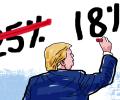
Several farmer organisations in India are protesting the proposed India-US trade deal, expressing concerns about its impact on the agriculture sector and demanding the resignation of the Commerce Minister.

In the 15 Union Budget presentation days of the Narendra Modi government since it came to power in 2014, the BSE benchmark Sensex has ended in negative territory eight times.

From the 30-Sensex firms, Maruti, Power Grid, Tata Motors Passenger Vehicles, HDFC Bank, Asian Paints and Tata Steel were among the biggest laggards. However, Titan, HCL Tech, Tech Mahindra, Infosys and Tata Consultancy Services were among the gainers.

'...but I would not like to put a timeline to it'
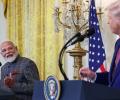
Of Trump's reciprocal tariffs and trade deals

New Zealand Prime Minister Christopher Luxon on Monday said the negotiations for a free trade agreement with India have been concluded.

Gor also announced that India will be a member of the Pax Silica alliance.
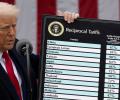
The move by the US President came following a retaliatory move by China, where it increased its tariff on US goods from 34 per cent to 84 per cent starting April 10.
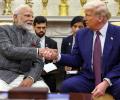
'President Trump believes in reciprocity and it is about time that we have a president who actually looks out for the interests of American businesses and workers'

US President Donald Trump has said that India should not be "dumping" rice into the United States market and he will "take care" of it, while stressing that tariffs will solve the "problem" easily.

Rahul Gandhi said that had an INDIA Bloc government negotiated the trade agreement with the US, it would have told US President Donald Trump that he should treat India as an equal.
Unless something changes, Mr Trump is a huge threat right now, which is perhaps not being recognised fully, cautions Debashis Basu.

Amid the ongoing global tariff war, Commerce and Industry Minister Piyush Goyal on Wednesday asked exporters not to panic and assured them that India is working on the "right mix and right balance" in its proposed trade agreement with the US.

Spokesperson of the Ministry of Foreign Affairs of China, Lin Jian, said on Wednesday that China supports Iran in maintaining its stability, adding that Beijing has always opposed the interference in other countries' internal affairs and the use of force in international relations.

Equity benchmark indices Sensex and Nifty advanced for the third straight session on Tuesday driven by firm global cues and optimism over India-US trade agreement, even as investors turned to profit-booking at higher levels.

From the 30-Sensex firms, HDFC Bank, Infosys, HCL Tech, Bajaj Finance, Tata Consultancy Services and Reliance Industries were among the biggest laggards. In contrast, Bharat Electronics, Hindustan Unilever, Tata Steel and UltraTech Cement were among the gainers.

Congress leader Rahul Gandhi has accused Prime Minister Narendra Modi of being 'anti-farmer' and 'selling' the country through the India-US interim trade deal, vowing to stand strongly with farmers.

US President Donald Trump said on Thursday that a news conference on reciprocal tariffs will be made later on Thursday.
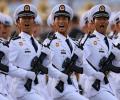
China's latest defence budget surges to $275 billion, fueling its ambitious military modernisation program and intensifying geopolitical dynamics in the region.

In another post, Trump is seen hoisting a US flag in Greenland, with a milepost that reads, "Greenland US Territory Est 2026".

State Bank of India, Tech Mahindra, Larsen & Toubro, Tata Steel, Sun Pharma, Infosys, HCL Tech, Axis Bank, Tata Consultancy Services and NTPC were among the biggest laggards among Sensex shares. Nestle, Hindustan Unilever, Titan, Power Grid, UltraTech Cement and ITC were among the gainers.
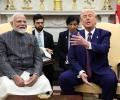
Deferment or rescheduling of the meeting assumes significance as the US has announced a staggering 50 per cent duty on Indian goods.

Trump called for immediate negotiations for the US to acquire Greenland from Denmark, describing the country as ungrateful, during his speech at Davos.

Inflation data, trading activity of foreign investors and global trends would dictate sentiment in the stock market this week, according to analysts.

In an event-heavy week ahead, stock markets are expected to track Q3 corporate earnings from several blue-chip firms, including TCS and Infosys, while inflation data and global trends would also dictate investors' sentiment, analysts said.

With US President Donald Trump "temporarily suspending" country-specific reciprocal tariffs until July 9, India sees the three-month window as an opportunity to renew its push for a proposed bilateral trade agreement (BTA) with the US and expedite finalisation of the first tranche of the trade deal.

MEA spokesperson Randhir Jaiswal said India's energy decisions are guided by national interest.

The question is no longer whether the war will expand. It has. The next few days will tell us whether the war stabilises around Hormuz or whether the Strait itself becomes the trigger for a far larger rupture. What to watch for over the next 48 hours is simple: Any move by the US toward direct naval control of the Strait; any credible Iranian attempt to disrupt or mine shipping lanes and, critically, whether energy infrastructure in the Gulf continues to be targeted.If those lines are crossed in tandem, the war will no longer be containable within the region.

India and the European Union are set to announce on January 27 the conclusion of negotiations and finalisation of a free trade agreement, which is aimed at boosting economic ties between the two regions amid disruptions in global trade due to US tariffs, an official said.

Prime Minister Narendra Modi on Tuesday announced the signing of the India-EU Free Trade Agreement (FTA), saying it accounts for 25 per cent of global GDP and one-third of global trade.
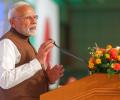
Showcasing India as an attractive investment destination, Modi said the country has political and economic stability as well as transparency and predictability in policy decisions.
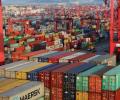
Imposition of high tariffs on China, Mexico, and Canada by the US is expected to help Indian exporters in increasing their shipments to the American market, experts say.

The Indian rupee, swaying through multiple headwinds, tiding over global trade disruptions and massive foreign fund outlfows, is unlikely to arrest its descent until tariff impact overhangs, notwithstanding robust domestic macroeconomic tailwinds. The Reserve Bank of India (RBI), which sees the rupee's depreciation as a silver bullet to offset the tariff shock, expects the currency to find its stable course once India reaches a trade deal with its largest trading partner, the US.

'We kept this Budget on a larger plank, rather than on one incident, however serious.'
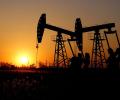
India possesses approximately 100 million barrels of commercial crude oil stocks, capable of covering 40-45 days of its requirements if flows through the Strait of Hormuz are disrupted, according to Kpler.
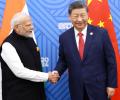
Chinese President Xi Jinping on Wednesday pledged to strengthen the strategic relationships with neighbouring countries by 'appropriately' managing differences and enhancing supply chain ties as China's tariff war with the United States escalated.
